
Last updated September 10, 2026
Full 25-point door and opener safety check with every visit - springs, cables, rollers, tracks, and your LiftMaster or Chamberlain opener included
You get a price before we start. It does not change when the truck arrives.
 Before
 After
After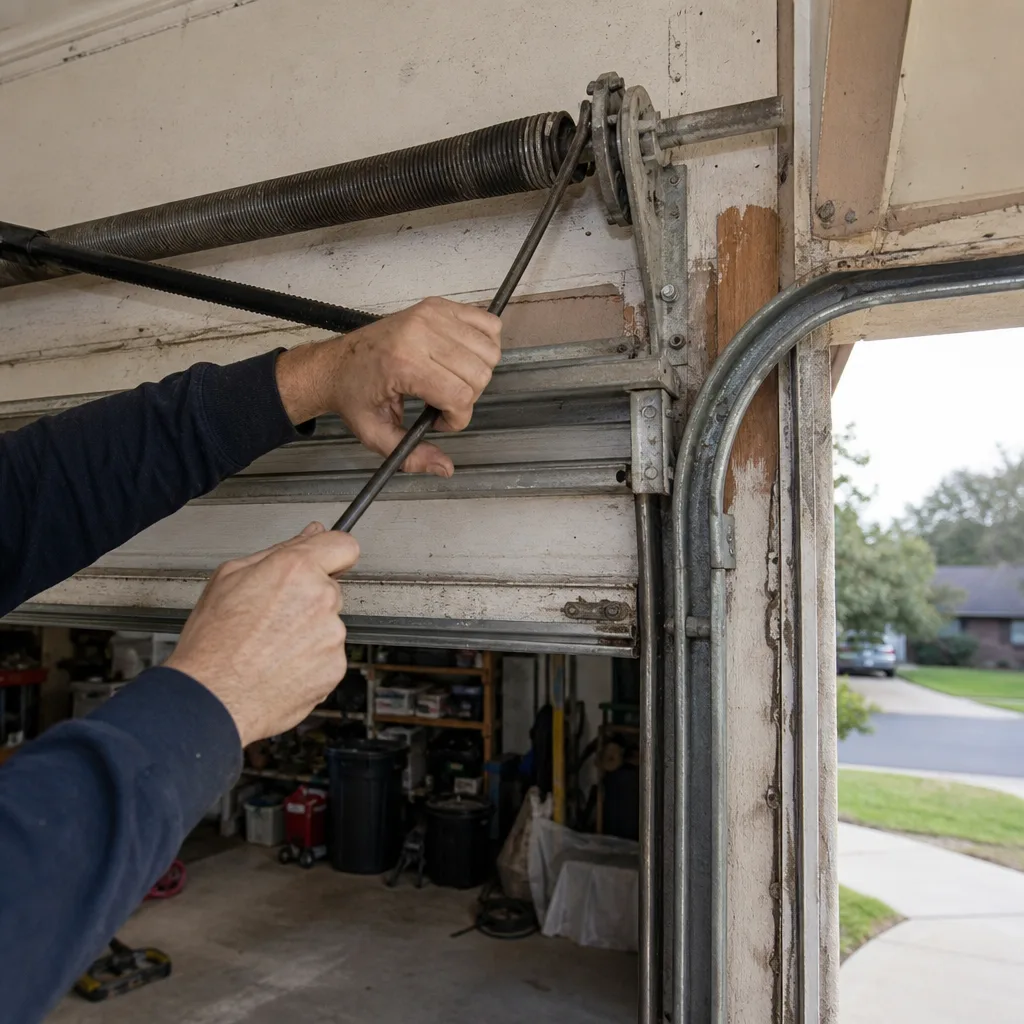 Before
 After
After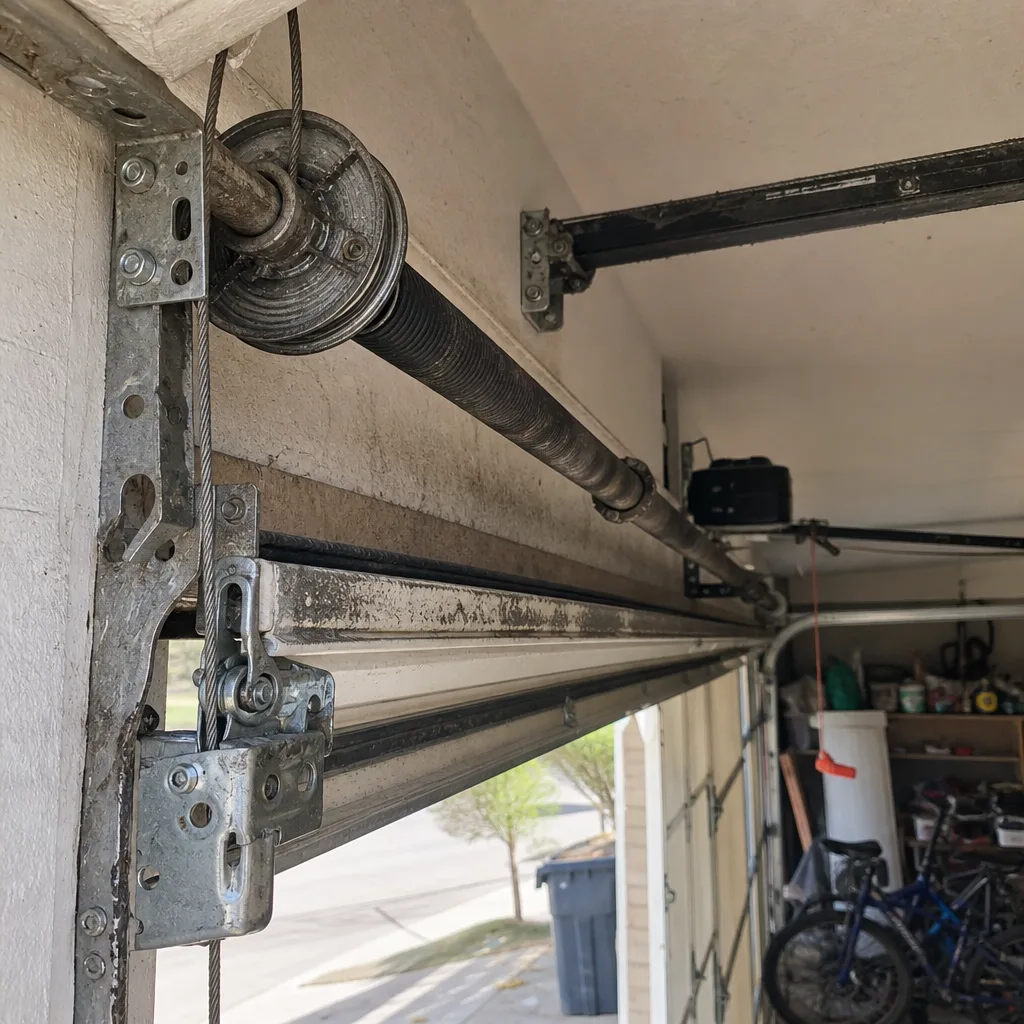 Before
 After
AfterDIY vs Professional Garage Door: The Flower Mound Homeowner’s Decision Guide
A garage door torsion spring stores roughly the same energy as a loaded rifle. The difference is a gun has a safety. In twenty years of fixing doors across Flower Mound, Otto has seen what happens when a spring releases on someone who didn’t know what they were unwinding into. This guide draws a clean line between the jobs a careful homeowner can handle on a Saturday morning and the ones that belong to someone who counts spring cycles the way you count tire miles, and it pairs well with our Garage Door Repair Maintenance Checklist for Flower Mound Homeowners. You’ll learn which fixes genuinely save you $150 or more, which ones will land you in the emergency room, and what it costs when a well-meaning DIY attempt goes sideways and the pros get called in to undo it.
Quick Answer
Some garage door tasks are genuinely safe for a Flower Mound homeowner to tackle: lubrication, sensor realignment, remote reprogramming, and weather seal replacement on the sides and top. The hard stop is anything involving torsion spring tension, cables under load, or track realignment after an impact. If the job touches a spring, a cable, or a bent track, call a professional. The savings from DIY disappear the moment a 200-pound door comes off its plane or a wound spring finds a wrist.
Table of Contents
- What a Flower Mound Homeowner Can Safely Do Themselves
- The Hard-Stop List: Jobs That Require a Professional
- The Physics of a Torsion Spring: Why This Isn’t Fearmongering
- What DIY Errors Actually Cost When We Get Called In
- How to Find a Legitimate Parts Source in Flower Mound
- The Time-and-Money Math: DIY vs Calling Otto
- Flower Mound-Specific Factors: Climate, Code, and the Clay Soil Problem
What a Flower Mound Homeowner Can Safely Do Themselves
Not every garage door problem requires a service call. Some tasks are straightforward, require tools you probably already own, and carry almost no risk of injury or property damage. Otto will tell you straight: he’d rather see a homeowner spend ten minutes greasing a hinge than pay him to do it. Here’s the actual list of jobs you can handle without calling anyone.
1. Lubrication
Every moving metal part on your door benefits from lubrication twice a year. Use a white lithium grease on the hinges, rollers, and the opener rail. Spray a silicone-based lubricant on the torsion spring itself. Do not use WD-40, which is a solvent, not a lubricant, and will strip whatever protection the parts have. In Flower Mound’s clay-heavy soil, dust kicks up easily, and dry hinges grind faster here than in wetter climates. A $8 can of grease saves you a $120 roller replacement and buys another few years on parts that would otherwise wear out early.
2. Sensor Alignment
If your door refuses to close and reverses immediately, the photo eye sensors at the bottom of each track are likely out of alignment. Dust, a bumped track, or a kid’s bike leaning against the rail will do it. Twist the wing nut holding the sensor, adjust the angle until the small LED lights on both sensors glow steady, and test. This is a five-minute fix that requires no tools beyond a screwdriver. We walk homeowners through this over the phone at nine at night more than you’d think.
3. Opener Remote Reprogramming
When a remote stops working and the wall button still opens the door, the issue is the remote, not the opener. Most LiftMaster, Chamberlain, Genie, and Craftsman openers have a “Learn” button on the motor head. Press it, press the remote button within thirty seconds, and you’re paired. If your neighbor got a new remote and suddenly your door moves, someone’s on the same frequency band, and reprogramming with a rolling code solves it. This is a $0 fix that takes two minutes.
4. Weather Seal Replacement on the Sides and Top
The vinyl trim around the sides and top of the door keeps out water, bugs, and drafts. It degrades in Texas sun within five to seven years, cracking and peeling away from the jamb. You can buy replacement weather seal at any hardware store in Flower Mound, pull the old strip off, and press the new one into the slot. The bottom seal, attached to the door itself, is trickier because the door must be moved and the track adjusted, and that one warrants a call. But the side and top trim is genuinely a homeowner job.
These four tasks save between $80 and $160 each compared to a service call, and none of them require touching anything under tension, as covered in our Garage Door Cost Breakdown: The Flower Mound Homeowner’s Reference for 2026. If you’re comfortable with a screwdriver and can follow a two-minute video, go ahead. For anything beyond this list, keep reading.
If you want to see the wider span of work we handle, the Garage Door Repair in Flower Mound page covers it in one place.
The Hard-Stop List: Jobs That Require a Professional
Here’s the line. We won’t shade it. These are the jobs that sent homeowners to the ER or cost them twice as much to fix after a failed attempt. Do not touch these. Not with YouTube open. Not with a friend who “used to work construction.” Not even if the spring looks like it’s still partly wound.
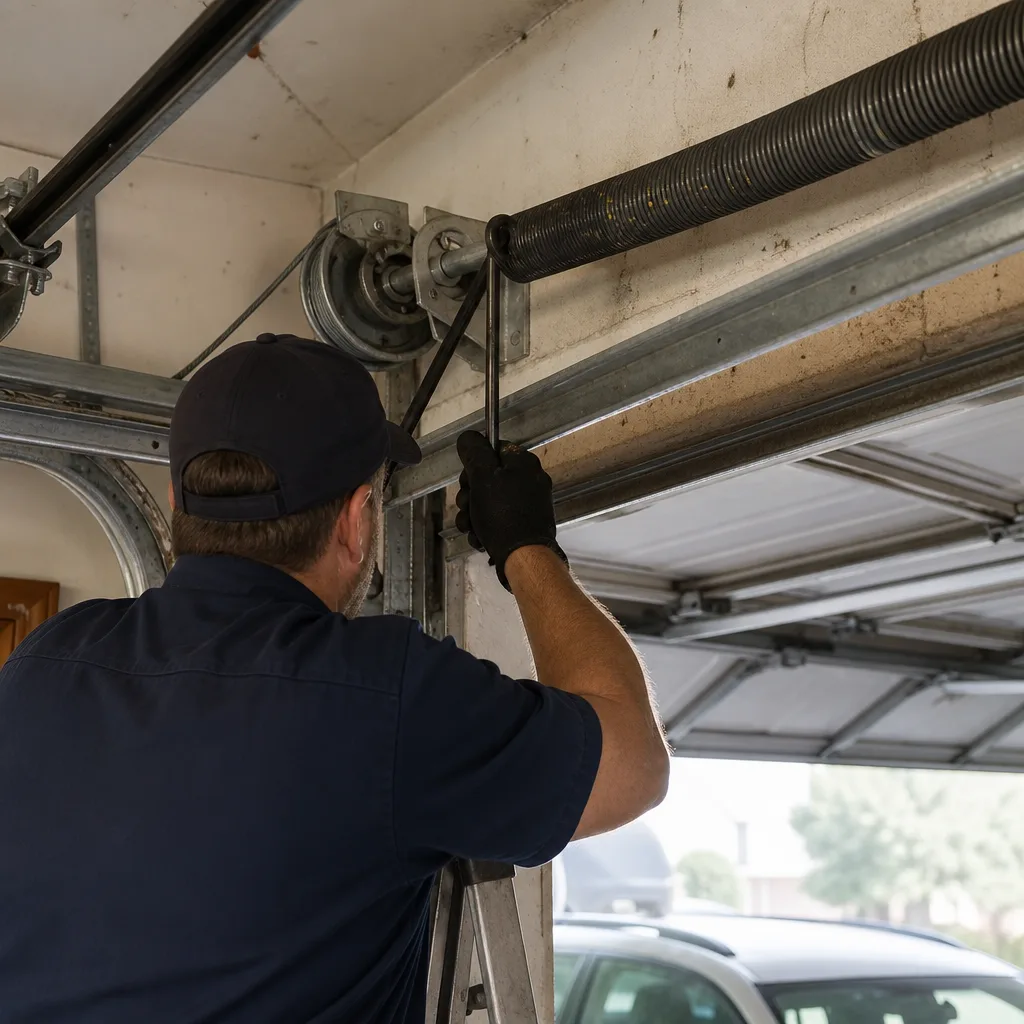
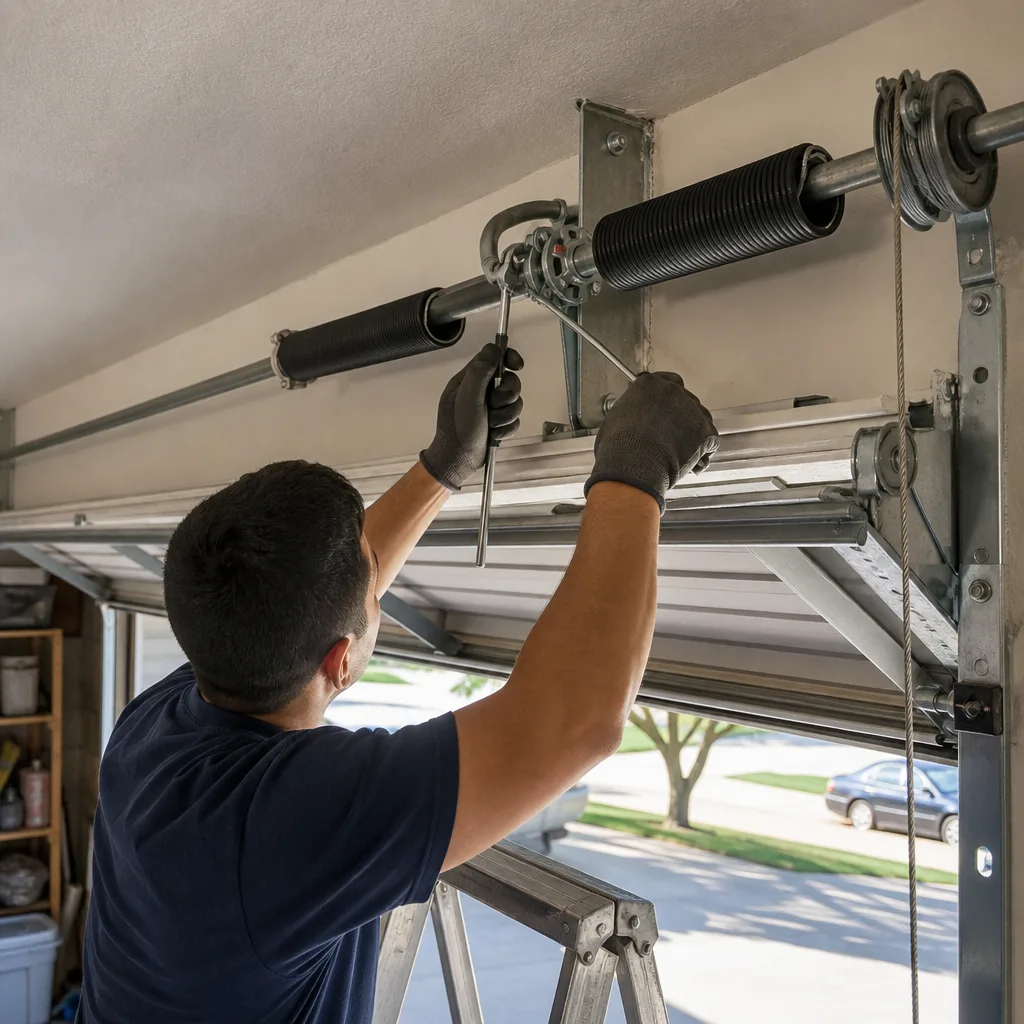
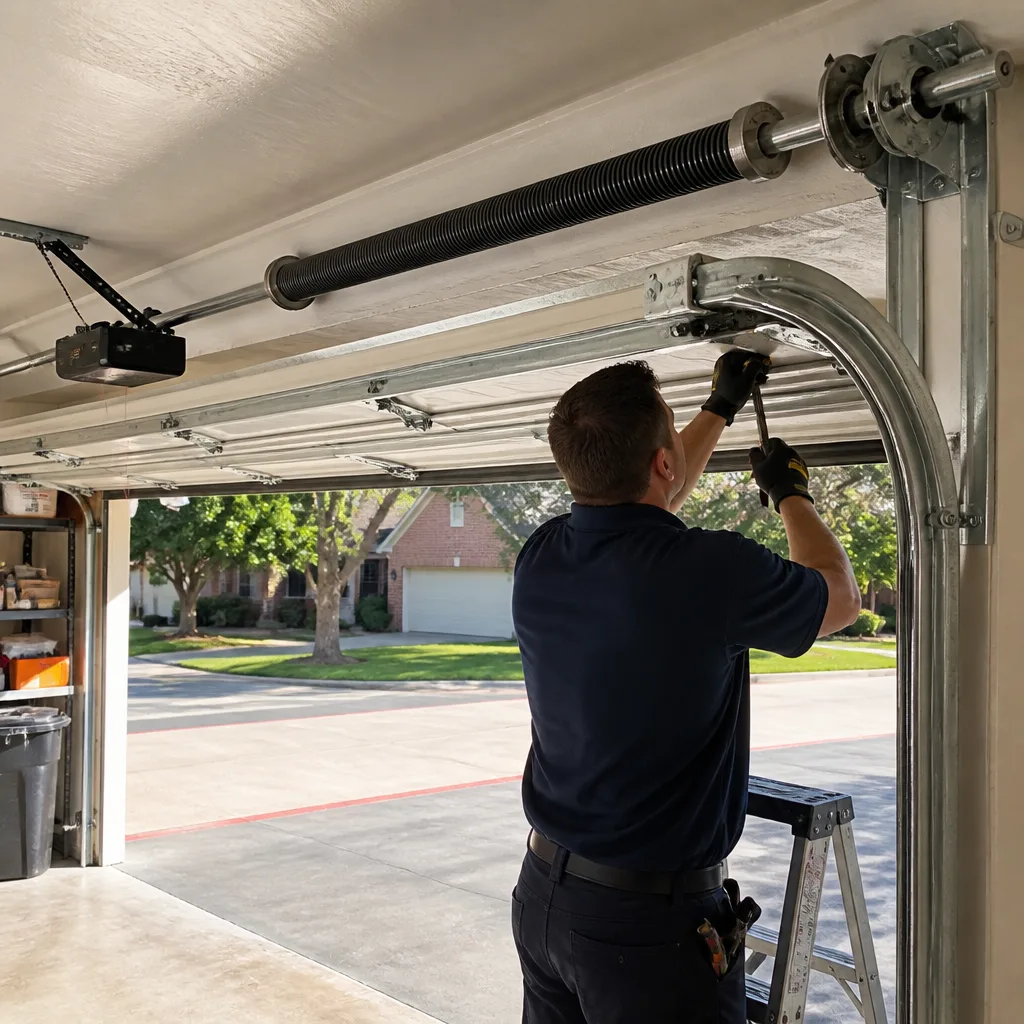
- Torsion spring replacement. The spring above your door holds between 100 and 250 pounds of torque, depending on the door. When it snaps during a DIY attempt, the winding bar becomes a projectile. Fingers, eyes, and faces lose that fight.
- Cable replacement. The cables running along each side carry the entire weight of the door when the spring system is out of balance. Cut or remove one cable while the other is still under tension, and the door drops or kicks sideways. A 200-pound panel doesn’t ask permission.
- Track realignment after an impact. After a car backs into a closed door, or a kid hits the rail, the tracks bend in ways that aren’t obvious to the eye. Bolting a bent track back to the wall without fixing the geometry means the door binds, the rollers wear fast, and eventually the opener strains itself to death.
- Bottom seal replacement requiring door lift. The bottom rubber seal attaches to a channel on the door’s bottom edge. To replace it, the door must be lifted and supported. Get that wrong, and the door can slip off its plane and come down.
- Spring adjustment (even “just a quarter turn”). There’s no such thing as a small spring adjustment. The spring is either under tension or it isn’t. Turning a winding cone without the right process is the exact moment an ER trip happens.
Otto has a saying: a door is 200 pounds riding on two springs. Respect it. That’s not a marketing line. It’s the difference between a $289 service call and a $40,000 hand surgery deductible. If your door is making noise, moving unevenly, or the spring has visible gaps in the coil, that’s a professional job. Full stop.
The Physics of a Torsion Spring: Why This Isn’t Fearmongering
Let’s get specific, because “it’s dangerous” doesn’t stick the way numbers do. A standard residential torsion spring on a 16-foot Clopay or Wayne Dalton door has a diameter between 1.75 and 2.5 inches, depending on the door’s weight. To lift a 180 to 220 pound door, that spring is wound to hold roughly 14 to 16 turns. Each turn stores about 10 to 14 foot-pounds of torque. Multiply that out, and you’re looking at roughly 160 to 220 pounds of torsional force waiting on a half-inch winding cone.
When a homeowner inserts a metal rod into that cone and loosens the set screw without controlling the rod, the spring unwinds in under a second. The rod travels through a quarter arc at roughly 30 to 40 feet per second. A metal bar moving that fast through a hand, a forearm, or a face does exactly what physics says it does. We have seen the aftermath. Otto doesn’t just tell you the spring is dangerous; he tells you the number and lets you make the call.
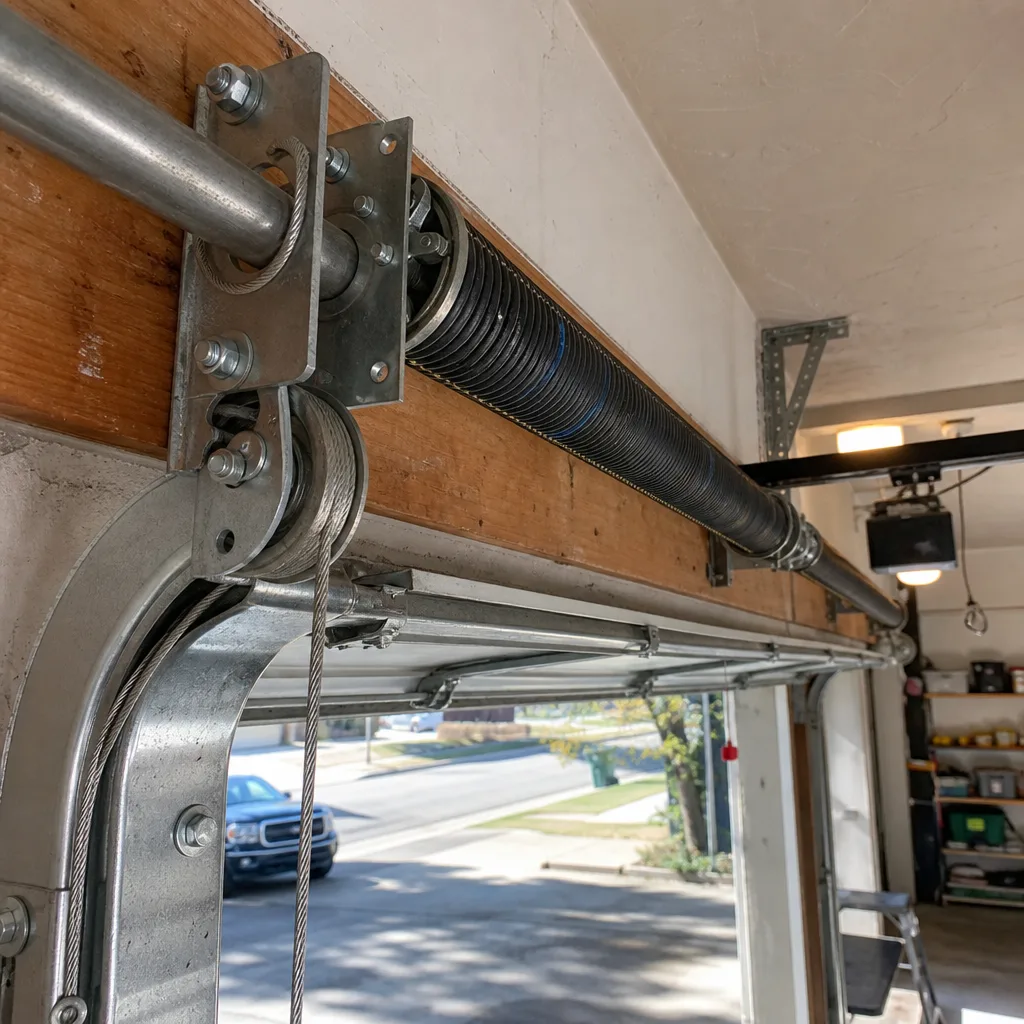
Here’s the part most DIY guides leave out: even if you survive the unwinding, the spring replacement itself is not just “put the new one on.” The new spring must match the old one’s wire diameter, inside diameter, length, and wind direction, or the door will be out of balance. An unbalanced door destroys the opener, wears rollers unevenly, and can sag on one side within months. The parts catalogs at a real supplier list these specs. The spring in a box at a big-box store does not. It’s a generic unit with a shorter cycle life and a one-size-fits-most assumption that doesn’t hold on a 1998 builders-grade door with a decade of Texas summer cycles on it.
And yes, someone is thinking it: “What about the winding bars? I’ll buy the right bars.” Winding bars are the safe tool, but the technique is learned, not read. The set screw on a winding cone takes a specific amount of pressure to seat without stripping. The spring must be stretched a quarter inch at installation or it binds. The left and right springs wind opposite directions. Miss any one of these details, and you’re replacing the spring again in six months, or calling us to fix what the first attempt broke.
If the door itself needs replacing rather than repairing, see Garage Door Installation in Flower Mound for what that process looks like.
What DIY Errors Actually Cost When We Get Called In
Here’s the part most guides won’t give you: the dollar figure. We see the same three DIY failures again and again, and Otto quotes them on the phone and holds that number at the door. This is what they cost in Flower Mound, in real 2026 prices.
Mistake 1: Replacing the wrong part
The opener strains, so the homeowner replaces the opener. Then the new opener strains too, because the problem was a broken spring, and the opener was never the issue. The original repair, a spring replacement, would have run $280 to $390. Now the bill is that spring replacement plus a new motor head because the first one burned out trying to lift a door without spring help: $620 to $850 all-in. We’ve seen it twice this year in Highland Village and once down in Lewisville. If the opener is straining, the problem is almost never the opener.
Mistake 2: The Home Depot spring swap
A homeowner buys a $39 spring kit from a big-box shelf, installs it with a YouTube tutorial, and it snaps within eight to fourteen months. The cycle life on a parts-counter spring from a real supplier runs 10,000 cycles. The retail shelf version often runs 5,000 or fewer. A door that cycles four times a day burns through 5,000 cycles in about three and a half years, and the retail spring fails in half that. The homeowner then pays for a second replacement plus the labor they were trying to avoid. Net cost: roughly $480 against the $340 they’d have paid Otto to do it right the first time, with a 90-day written guarantee they didn’t get from the shelf.
Mistake 3: Silicone on the wrong thing
Silicone spray is the right product for the torsion spring. It is the wrong product for the roller bearings, which are sealed and should not be sprayed, and the wrong product for the track, where it collects Texas dust and turns into a grinding paste. We’ve pulled doors apart where the tracks were so gummed up with spray-and-dirt slurry the rollers wouldn’t spin. Cleaning and replacing contaminated rollers runs $145 to $185, and the fix is to simply not have sprayed the track in the first place.
In every one of these cases, the homeowner wasn’t stupid. They were underinformed. That’s the whole reason this guide exists: so the next person doesn’t pay tuition on the same lesson.
How to Find a Legitimate Parts Source in Flower Mound
If you’re going to do one of the safe tasks yourself, you need parts that won’t fail early. Here’s how to find them, and why it matters.
- Skip the big-box shelf for anything under load. The springs, cables, and rollers at big-box hardware stores are built to a price point, not a cycle rating. A Clopay or Amarr door sold through a dealer has parts engineered for that door’s weight. A generic spring off the shelf doesn’t know if it’s lifting a fiberglass 8×7 or a wood carriage door.
- Find a local garage door parts distributor. Flower Mound sits between two real suppliers: one on the Carrollton side and one over in Grapevine. These places sell to contractors but will also sell to a homeowner who knows exactly what they need. Bring the old part, the door brand, and a photo of the spring’s paint stripe. The paint stripe tells the supplier the wire gauge. No paint stripe on the new one means you’re guessing.
- Buy by cycle life, not price. A 10,000-cycle spring costs $60 to $90 at a distributor. A 5,000-cycle spring costs $29 to $39 on a shelf. You’re not saving $30; you’re prepaying for the next failure.
- If the supplier asks questions you can’t answer, stop. If the person at the parts counter asks the door weight, the spring wire diameter, or the wind direction and you can’t answer, you’re buying the wrong part. This is the moment to call someone who can answer those questions off the top of his head.
And the quality difference applies beyond springs. A Craftsman opener from a licensed dealer carries the same programming but includes better rail components than a stripped-down box version. The subtle spec differences compound over ten years of daily use.
The Time-and-Money Math: DIY vs Calling Otto
Let’s do the math on a real job: a door that’s gotten loud, shaky, and occasionally reverses. A Flower Mound homeowner has two options.
Option A: DIY weekend. Saturday morning, watch three YouTube videos. Go to the hardware store for grease and a new bottom seal, which takes an hour including the drive. Spend another hour figuring out the seal doesn’t fit your 2003 Clopay door because the channel size changed. Drive back, return it, buy a different one. Spend two hours wedged under the door, scraping old adhesive off the concrete. Sunday, the door still shudders, because the real problem was worn rollers and an out-of-balance spring, which you didn’t diagnose. Total cost: $85 in wrong parts, six hours, two trips, and the door still isn’t fixed. Now you call Otto anyway, and he replaces the rollers and rebalances the door for $240.
Option B: Call Otto first. One phone call, answered by a live person. Otto asks what the door is doing, quotes the likely range over the phone, and holds that number when he arrives. He replaces the rollers, lubricates what needs lubricating, adjusts the spring balance, and tells you honestly what’s fine to leave alone. Total cost: $240, 90 minutes, and the door runs like it did in 2010. The 90-Day Done Right Promise is on the invoice.
The DIY option costs more money in parts, more time, more frustration, and the door still isn’t fixed at the end of it. The math doesn’t favor YouTube on this one. For jobs on the safe list, DIY saves real money. For diagnostics and anything under tension, the invoice for doing it wrong is always bigger than the invoice for doing it right the first time.
If the problem is the opener itself, the Garage Door Opener in Flower Mound page has the details on what we check before replacing anything.
Flower Mound-Specific Factors: Climate, Code, and the Soil Problem
Garage door life in Flower Mound isn’t the same as garage door life in Houston or Plano. Three local factors matter, and most generic guides never mention them.
The heat and the spring cycle life
North Texas summers hit 100 degrees regularly, and a door in direct afternoon sun absorbs all of it. The metal expands, the spring steel fatigues faster, and a spring rated for 10,000 cycles in a garage that stays 85 degrees gets more like 8,000 when the ambient temp inside the garage hits 110. Otto counts spring cycles the way you count tire miles. Ask him what’s left on yours, and he’ll give you a straight answer.
The clay soil and the shifting slab
Flower Mound sits on expansive clay. The soil swells when wet and shrinks in drought, and the slab under your garage door moves with it. Doors that ran true on a slab poured in the 1990s can be a quarter inch out of plane a decade later. A door that suddenly scrapes on one side or leaves a gap at the bottom isn’t always a spring issue; sometimes the slab has shifted, and the track needs shimming. A homeowner sees the scrape and starts adjusting the opener force, which makes it worse and burns out the motor. We see this exact diagnostic path in Double Oak and Bartonville more than anywhere else in the county.
Permits and the flower mound code office
New door installations in Flower Mound require a permit, and the code office checks for wind load ratings-see Garage Door Permits, Codes & Inspections in TX: What You Need to Know. A door rated for 90 mph wind is standard for this area, and the bracing requirements are specific. A homeowner who orders a door online without wind-load certification can get flagged at the permit desk and end up with an unpermitted installation that catches up at resale. The tax appraisal district and the HOA in many Flower Mound neighborhoods also care about door color and style conformity. Our installation process handles the paperwork end; the homeowner’s part is knowing the requirement exists.
When the slab has shifted and the door won’t sit square, that’s not a DIY job and it’s not a YouTube job. It’s a shim-the-track-and-rebalance-the-spring job, and it’s the kind of thing we do on a Tuesday morning in under two hours.
Common Mistakes to Avoid
- Spraying the tracks with lubricant. Tracks should be clean and dry. Lubricant collects the fine dust of a Texas summer and turns it into paste that grinds rollers into flat spots. Wipe the tracks, don’t grease them.
- Loosening the red bolts. The bolts painted red on a torsion spring assembly are under tension. If the bolt is red, it is load-bearing. Do not touch the red bolts. This is universal across every major brand, including Amarr and Wayne Dalton.
- Adjusting the opener force to “fix” a hard-to-open door. The opener is a motor, not a doctor. Cranking the force setting past the factory spec means the door keeps running when it should reverse, and that’s how a 200-pound door closes on a car hood or a kid’s bike. The harder the door is to lift, the more likely the spring is the problem, not the opener settings.
- Replacing one spring instead of both. When one spring goes, the other one is the same age and has the same cycle count. Replacing only the broken one means the old one fails next month, and you pay for labor twice. Otto always recommends both, and the math favors it: two springs at one visit cost less than two springs at two visits.
- Buying the cheapest remote on Amazon. The $14 universal remotes often fail to pair with a rolling-code Chamberlain or LiftMaster, and the return window closes before you figure it out. A genuine remote from the manufacturer runs $35 to $55 and works the first time.
- Painting over weather seal. Paint sticks to the vinyl trim and cracks it within a season. Replace the seal, don’t paint it. Flower Mound HOAs notice painted-over trim.
When to Call a Professional
Call the moment the spring breaks, the door comes off its track, a cable frays, or the door reverses mid-close without touching anything. Call when the opener makes a grinding sound it never made before, or when the door shakes on the way up. These are not diagnostic puzzles for a weekend. They’re mechanical failures with real consequences, and the person answering the phone at Otto’s Garage Door has seen every one of them in this county since 2004. Otto quotes the job on the call and holds that number when he gets there, and the price is agreed before any work starts. Free estimates in Flower Mound, no trip charge inside the county: call (817) 631-5388.
Frequently Asked Questions
Spring replacement in Flower Mound typically runs $280 to $390 for a two-spring replacement on a standard 16-foot door, with both springs replaced at the same visit. The exact number depends on the door weight and spring cycle rating. Call (817) 631-5388 for a quote over the phone, and the number holds when we arrive.
No. A torsion spring holds 100 to 250 pounds of torque, and the winding bar travels fast enough to break bone when the spring releases. This is not a difficulty issue; it’s a physics issue. Hire someone trained, licensed, and insured.
Twice a year, lubricate the hinges, rollers, and spring with the right products, and wipe down the tracks. Test the auto-reverse by placing a 2×4 under the door and closing it; if the door crushes the wood instead of reversing, the opener force is set wrong and needs attention. The climate here demands more frequent lubrication than the national average.
In most cases, the photo eye sensors at the bottom of the tracks are misaligned or dirty. Clean both lenses with a dry cloth and check that the small LED on each one glows steady. If the sensors are clean and aligned and the door still reverses, the problem is a broken or out-of-balance spring, and that’s a repair call.
A 10,000-cycle spring on a door that cycles four times daily lasts seven to ten years under normal use, but the Texas heat reduces that by a couple years. A 5,000-cycle spring off a retail shelf lasts half as long. We count spring cycles the way you count tire miles; ask us what’s left on yours.
Yes. Otto’s trucks carry springs, cables, rollers, weather seal, and opener components across all major brands, so most repairs finish in one visit. Call (817) 631-5388 to confirm the specific part we need for your door, and we’ll bring it.
The Bottom Line
The line between DIY and professional garage door work isn’t drawn by skill; it’s drawn by physics. Anything that doesn’t touch tension, load, or a bent track is a fair Saturday project. Anything that does is a job for someone who has spent twenty years in Flower Mound garages and carries the name Otto Reinhardt on the invoice. The safe list saves you money; the hard-stop list saves you worse. If you’re not sure which side of the line your problem falls on, explore more guides & resources or call (817) 631-5388 and ask. A live person answers, including at nine at night when the spring lets go and your truck is sealed inside.
Written by Otto Reinhardt, Owner at Otto’s Garage Door, serving Flower Mound since 2004.